
I just love the concept of decentralization – a major reason for my blockchain love.
I have written here on how smart contracts can disrupt the Insurance industry and process claims faster.
We believe smart contracts and various protocols on the blockchain are unbreakable. Even then, mishappenings can occur.

How do we make sure that people won’t be affected in any way in those cases?
I’m expecting your answer – An insurance, right?
You’re damn right.
Few companies are taking bold steps in that direction. Let us look at what Nexusmutual is all about.
‘Get covered against smart contract failure & exchange hacks.’
This is the first thing you see when you check out their website. And this is exactly what they are intending to solve.
As the DeFi space is evolving, it is no wonder that startups are stepping up to mitigate the risk involved in scenarios like these.
Nexusmutual clearly is a people-powered alternative to insurance. It is an ethereum-based platform.
In a way, they are taking insurance to the next level.
But how does this whole thing work?
Just like how we purchase covers for various scenarios in normal insurance, here you can purchase covers for various instruments like Yield Token, Protocol, or Custody. We can then choose a fixed sum called the cover amount which flows into the capital pool.
We can claim this cover amount for valid reasons that will be paid out if the claim is approved by the claims assessment process.
Also, remember that we get paid the cover amount, not the losses caused by the smart contract bug.
How do I get the cover?
This is a confusing part for many of us. The sole reason is that we deal with altcoins and tokens here, unlike pure cash like before.
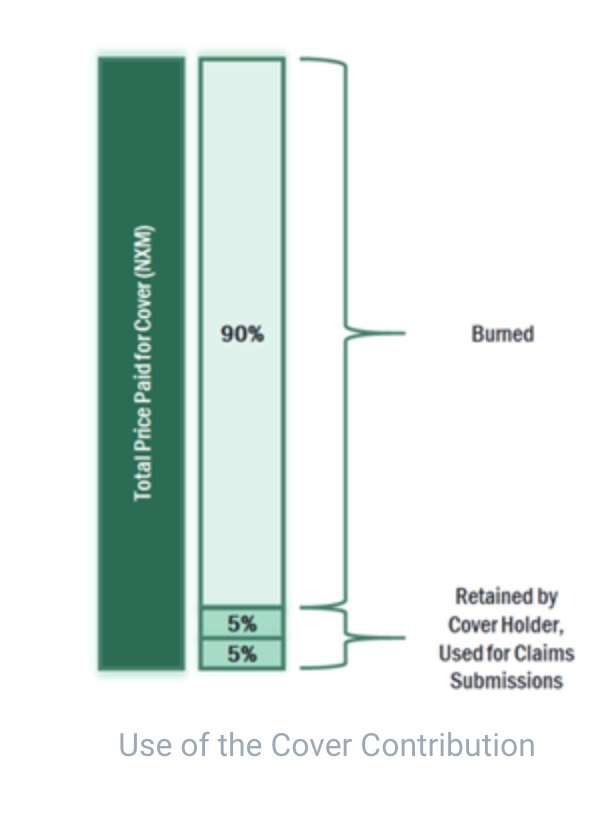
We can buy it using either ETH, DAI (a USD stablecoin), or Nexus Mutual Tokens (NXM). If paying in DAI or ETH, the system effectively purchases NXM tokens on your behalf before purchasing cover.
Of those NXM tokens, 90% is used(“burned”); the other 10% remain with the member and are either used as a deposit when submitting claims or are returned to the cover purchaser if no claim is made.
Putting it simply, just like how you pay for normal insurance, the cover amount is ‘burned’ if we don’t have any claim during the covered period. The difference here is that the amount we used to buy the cover is used to purchase NXM tokens (a native token of NexusMutual). 10% of which is used for any further transactions like claims.
Now, I know what is running through your mind.
How does the claim assessment process work?
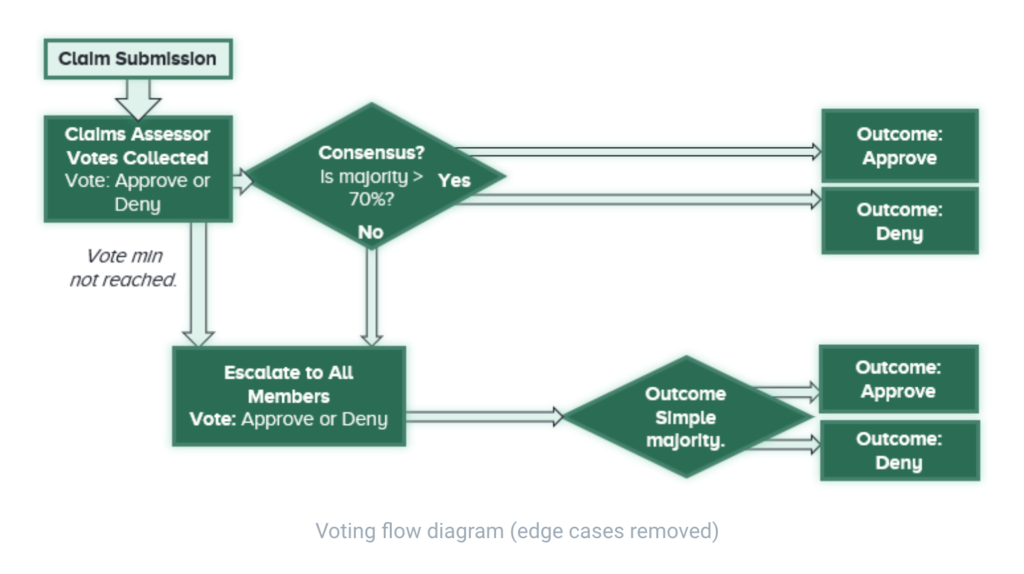
As the core element of any blockchain-based system, this happens through consensus.
Unlike an Insurance company, it provides a platform where members can act as Claims Assessors by voting on claims submitted by other members.

I see two aspects playing out here.
If the claim gets rejected, there’s no way a member can appeal to a higher authority, because there is no higher authority.
On the other hand, genuine claims can be approved as there are no set rules like an insurance company. If the majority of the assessors feel the claim is genuine, then there are no roadblocks. In short, there’s increased flexibility in the whole process.
Since this is a community process and no single entity is the decision-maker, there have to be incentives for the members to assess the claims.
This is just like any system that runs on blockchain.
Let me tell you an example.
I’m sure you have heard about the bitcoin miners. In bitcoin, it was the miners who were responsible to approve the transactions that happened on the bitcoin blockchain. They did this by solving cryptographic puzzles backed by their computing power.

What was the incentive for them? It was the bitcoin itself – a fixed percentage.
Now, what is the reward for the claims assessors?
In order for this to work, incentives need to be aligned between members submitting claims and members acting as claims assessors.
This is done through an economic incentive/punishment mechanism.
Members who vote on claims have a strong incentive to vote honestly on submitted claims.
In the same way, members who vote on claims are deterred from voting fraudulently.
In essence, all consensus mechanisms work on the core belief that the majority of human beings act honestly. And selfishly, when we think from the fact that all of us act for our gains.

Here, those who vote with the consensus outcome get rewarded, and those who voted fraudulently get punished. The rewards and punishments happen in NXM rewards and the way they can use them.
What happens if a person submitted a fraud claim?
For submitting a claim, the person has to stake 5% of his NXM tokens. If the claim is fraudulent, that gets burned.
I love one more factor of this mechanism, for that matter, any system that uses consensus mechanisms.
This is a principle-based case-by-case assessment of each individual. Contrary to the extensive set of terms and conditions to assess what’s and what’s not is paid in regular insurance.

I have heard about experiences where someone forgot to read a clause on the insurance policy and had a hard time getting the cover amount. This is a perfect solution in those scenarios as well.
Also, please note that it is inherently cumbersome for a normal insurance company to have coverage schemes for evolving tech like this.
Now, there are complexities in the process that I haven’t mentioned here deliberately. I just want to make you understand how blockchain and its potential are evolving.

For instance, we just thought of cryptocurrencies in the early stages, then we have decentralized apps getting built on various blockchain platforms, we have NFTs and countless other innovations and applications mushrooming cheerfully.
And now we have seen community-centered insurance for smart contracts. I’m sure that we’re looking at an entirely new technology spreading its wings in front of our eyes.
As always, long hail decentralization!
Leave a Reply