
Gone are the days where you struggle figuring out what your teacher says by your imagination.
Virtual reality is bringing you a brand new way of learning. It enables you to learn through experiences. That too using ultra-modern equipments by a fraction of its real cost.
We know that technology is breaking up things and molding new stuff at an exponential rate now. So what we see in modern universities will be possible in our local schools at a shorter period than we can imagine.
This can impact the learning community and the whole process in several ways
1. Figure out what their passion is
Now think for a moment. How did we reach this point in our life? We chose a certain career path that may or may not be our passion. And how did we choose a particle career path? We chose among the choices we had or we knew about.
Maybe if we knew more about a field in detail and its practicalities in the real world or completely new fields altogether, would we have chosen the same path?
There is a high probability that the answer can be a ‘No’. The whole process can be a trial and error method.
“You can’t be, what you can’t see” – Marian Wright Edelman
By Virtual reality, students can experience the practical applications of a wide variety of fields. This enables them to find out their passion and pursue them at an early age.
By the power of VR, a middle schooler can become a marine biologist, even if he hasn’t seen the ocean.
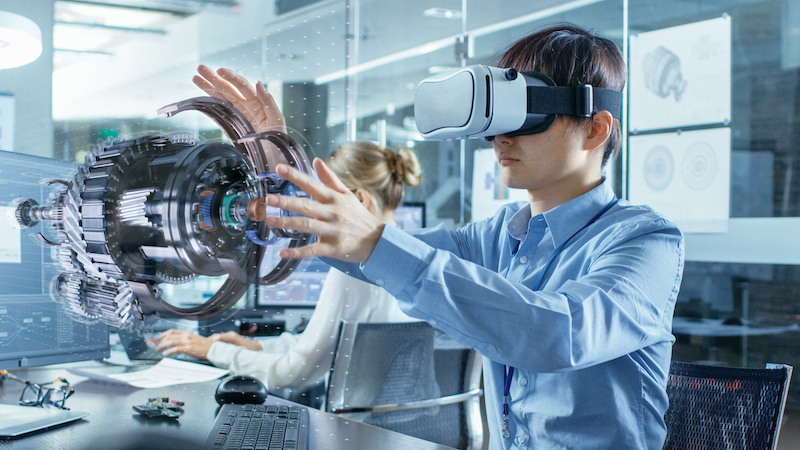
Today, there are limited possibilities for students to get exposed to fields like biotechnology, rocket science, etc. By VR, they can experience those fields and figure out whether their passion lies there.
In short, VR enables them a realistic experience of a scientific career.
But why is this important?
Very few middle school students are passionate about science these days.
By a study in 2014, 57% of 8th and 9th-grade students don’t see themselves in anything related to science in their future.
No one wants to become a scientist.
More people would opt to become a social media influencer than a scientist.
Nothing is wrong with this thinking. But there might be students who would want to become scientists if they were exposed to the possibilities of science.
And we need scientists along with a wide variety of fields in our next generation.
2. Making education far more effective
The world is growing incredibly fast. And with that growth comes a whole list of challenges. Challenges like global warming, climate change, new diseases, etc.
Our current education system is highly inadequate for the younger generation to solve these real-world problems. Current education is found to be boring, ineffective, and expensive.
Students are not sure why they are learning about a topic in the first place.
This is where the new innovative teaching methods are important.
You might say we are already there. I highly doubt it.
What we have now is books turned into e-books, blackboards into youtube videos and lectures in MOOCS(massive online open courses). Yes, this new format helps in easy access and reaching out to more number of students which is great.
But there is no major innovation in this teaching method.
Virtual reality can transform the teaching and learning experiences through its highly immersive content. Students can experience the content they are learning which helps in solving real-world problems.
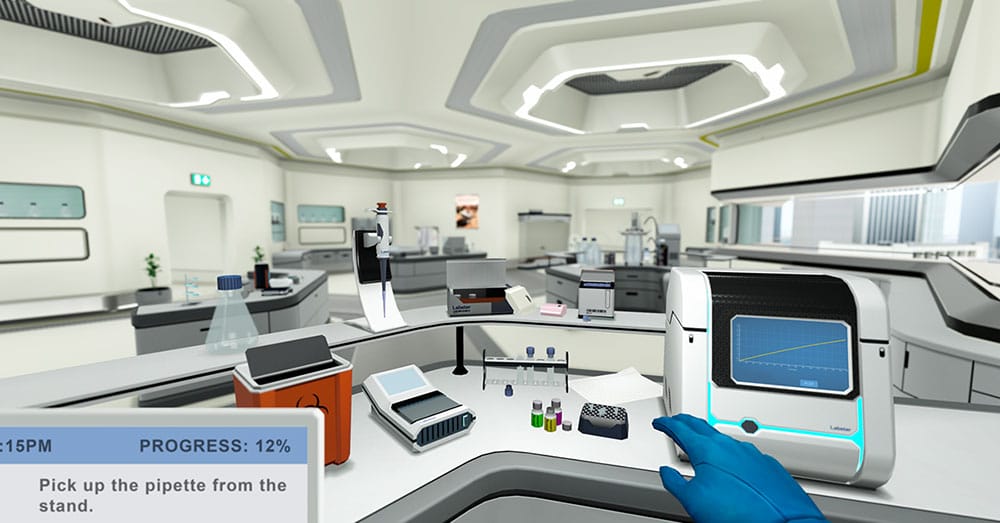
There is a startup called Labster which uses virtual reality to create highly advanced virtual laboratories.
They have created a fully simulated one to one virtual reality laboratory simulator, where the students could perform experiments with mathematical equations that would simulate like in a real-world lab. The students can perform virtual experiments before they go into the real laboratory. They could conduct dangerous experiments in these virtual laboratories without any real-life implications. For instance, they can perform ‘salmonella’ bacteria experiments which many schools cannot teach due to good safety reasons.
There are games created in VR where students can apply their core science skills to solve problems.
A study conducted by Stanford University and Technical University, Denmark has shown that the learning effectiveness has almost doubled in the same amount of time when normal teaching methods were combined with the VR.
3. Making learning interesting
We all have been there, where we felt learning on certain topics were boring and a time wastage. Learning using the power of virtual reality is highly engaging and super interesting. This makes students spend more time in valuable learning than spending a major chunk of their time, consuming content through social media. The major reason behind this is the VR experience is highly immersive and engaging for students.
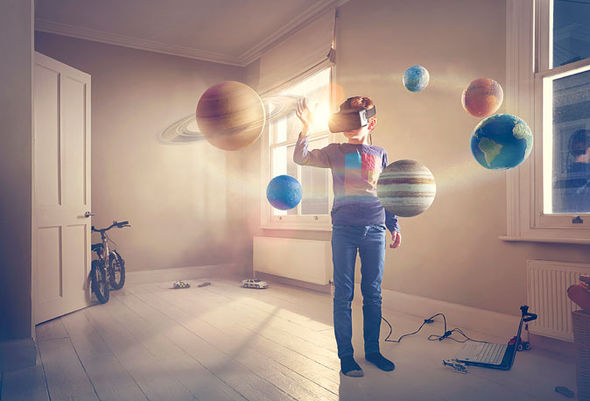
Virtual reality can transform the way we learn things. Any person would be ready to learn and grow if the whole learning process is highly interesting and super engaging.
The possibilities are endless with VR.
Leave a Reply