
Are you ready to introspect?
Let’s start with a new product/service.
Look at the adopter categorization based on innovativeness.
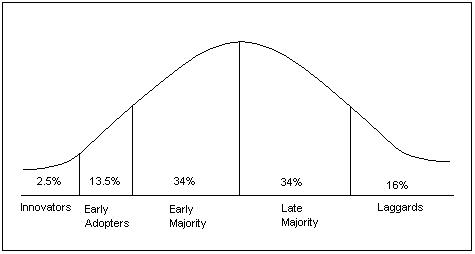
There are 5 adopter categories:
- Innovators
- Early adopters
- Early majority
- Late majority
- Laggards
Innovators
Innovators are eager to try out new ideas.
You know it now whether you come across this category.

Have you tried getting your hands on when a new iPhone is released?
Doesn’t matter, whether you got it or not?
Are you actively looking for products/services that make your life simpler even if no one has heard about it in your circle?
If you really needed to try that first experience, then you probably come into this category.
Or you were the one who actively encouraged your peers, family, and friends to try out that new online service that you feel is super convenient.
There’s an additional point to be noted as well.
Generally, people who keep getting their hands on the latest gadgets might have a lot of financial resources.
Along the same lines, if you’re curious about trying out new ideas – a product or a service – then you’re an innovator.
This crowd can be more cosmopolitan and tend to have more technical knowledge.
And they introduce new services and products to their peer groups.
Let’s see who comes next.
Early adopters
These are the people who actually bring real traction to the product/service. They are mostly localites compared to cosmopolitan innovators.
Also, these can be the people who are opinion leaders in the social systems.

People look up to them for their opinions on new stuff as they tend to be wise decision-makers.
So, change agents seek out these opinion leaders to make their product/service spread faster among the communities.
And they tend to choose better products/services because we have some feedback coming in from the innovators.
Early majority
The name pretty much gives away who they are.
They adopt the ideas much faster than the average member of the social system.

They willingly try things out if the idea is gaining traction among the first two categories of people.
So how does the idea really spreads?
The early majority accelerates the diffusion process.
Late Majority
I know you got it from the name. They’re a little skeptical of the innovative ideas and only adopt them once that has been diffused in the social system pretty far and wide.

It often happens when someone asks them – ‘Hey do you have Phonepe so that I can transfer the money?’
‘Can you join the Slack group for the updates?’
We can simply state their adoption as an economic necessity and peer pressure.
They don’t drive the change, they are forced to change.
Laggards
You know it. Anyone who doesn’t fall into any of the previous categories comes here.
They’re traditionalists and maybe even advocate against the innovative ideas and the people behind them.

By the time, they adopt the ideas, the initial innovative ideas we talked about might have given way to more innovative ones.
And during this time, the innovators might be experimenting with brand new ideas.
Now, you just think about which category you fall into.
These are the categorization for the new product/service ideas.

Part 2: Social Changes
And I believe we can just map out a similar categorization to ideas that causes social changes.
There will be few original thinkers that cause the root of an idea and come up with their unique thinking on why that makes sense.
On a higher note, why those ideas will make real good changes in society.
This is a great thing as you might think. But, they face a huge risk when they do this.
They can be called crazy by the majority section of society.
The most prominent reason is that others cannot see the vision that they see.

3 major factors play out here.
The first one – they should be smart and experienced to come up with original ideas.
The second one is – They should really care about society, and not just themselves.
Why?
Because the reward is kinda unpredictable. They can be outcasted from society or they can be hailed.
The hailing part is pretty rare, at least in the initial stages.
The third one is – They have to be brave.
Even if you have original ideas that potentially will create a positive impact in society and the person behind them really care about the people around them(society), it doesn’t make any difference if they don’t come out bold and take chances to propagate their ideas.
And this is for sure a swim against the currents.

Eventually, most of these folks who do all of these above tend to stop because there comes a time when you have to choose your life or the greater good.
And that’s a pretty straightforward proposition for most of us.
So what is the smallest effort that we all can do if we wish our lives to be better, in a whole sense?
Support and appreciate the ones behind those crazy ideas, when you see a new spark of a good idea that you think is good.
Because they have come a long way to reach that point.
Just try flaming it with your little wind rather than blowing it off.

That’s one of the reasons why I have huge respect for people who take chances and try implementing ideas – from a startup perspective and from a social perspective.
More support for the social ideas for sure.
The reason – there’s little to gain from them monetarily and the risk is potential outcasting from their community.

I hope you have gotten an idea of the innovation theory in the first part.
And how we can use our little effort to flame the social changes branching out from the previous analogy.
Thanks for your time, really appreciate it.